


自制 AI 助手机器人:Arduino 与 Python 协同实现语音交互与肢体动作
所需组件与物料
| 组件 | 数量 | |
|---|---|---|
| Arduino Nano R3 | 1 | |
| SG90 微型舵机 | 3 | |
| HC-SR04 超声波测距模块 | 1 | |
| PCBWay 定制 PCB | 1 | 项目链接 |
所需应用与在线服务
- Arduino IDE
- Python 3
项目简介
引言
《钢铁侠》中的“贾维斯”始终是程序员的梦想。本项目展示如何用 Python 实现语音助手核心,并配合 Arduino 控制实体机器人做动作,比纯软件助手更酷。机器人命名为“Jaundice”(黄疸),因整体喷漆成亮黄色。
核心部件清单
电子部分:Arduino Nano ×1、SG90 舵机 ×3、HC-SR04 超声波 ×1
机身结构:PVC 板(白色利于上色,我用蓝色)、舵机轮(做底座)
工具:美工刀、剪刀、热熔胶、喷漆
软件:Python 3、Arduino IDE
系统原理
AI 核心运行在电脑端(Python 语音识别、NLP、语音合成、浏览器自动化、串口通信),Arduino 通过 USB 连接电脑,仅负责执行预置动作函数。Python 发送单字节指令(如 'h' 触发挥手),Arduino 解析执行对应动作函数。
电路与 PCB 设计


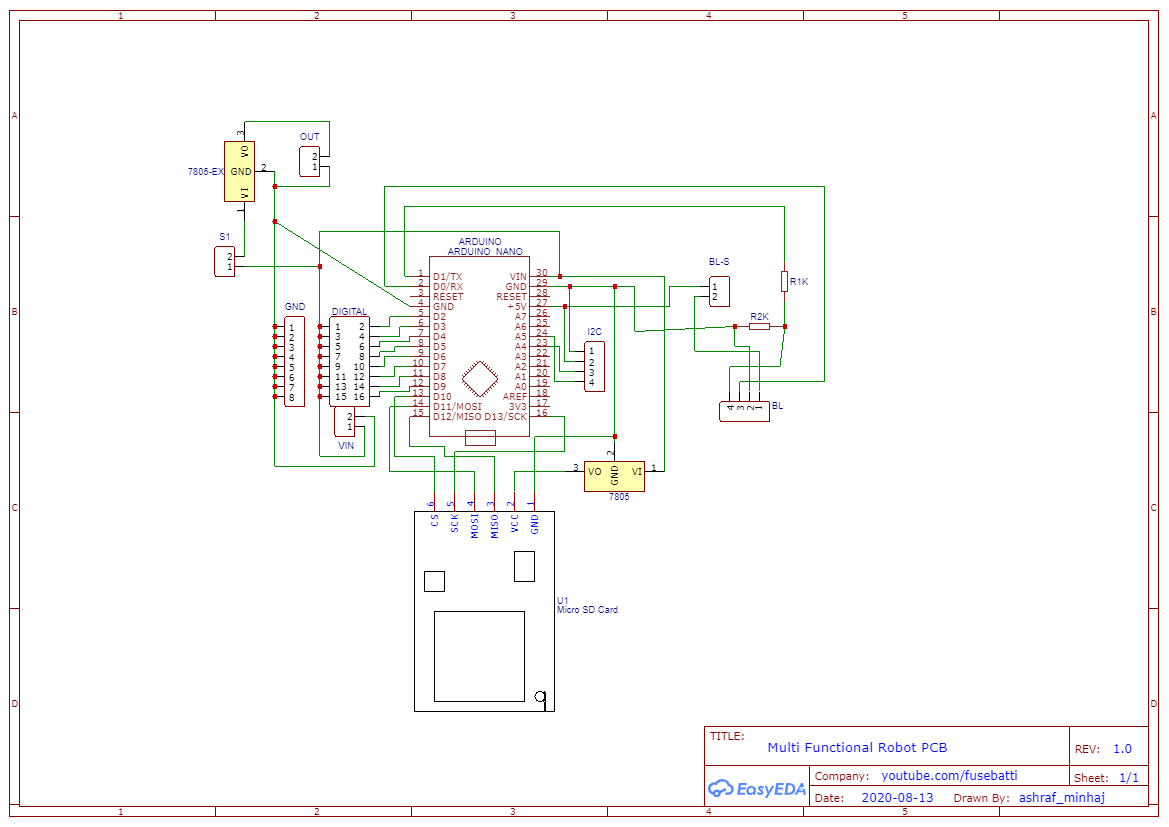
为避免飞线烧毁元件,我用 EasyEDA 设计多功能 PCB(含 microSD、蓝牙模块座、5V 外部供电接口),通过 PCBWay 打样,3 天从中国寄达孟加拉,品质优秀。走线宽 0.3mm 可承载 1A 电流。PCB 文件可在项目页下载。
焊接与测试

焊接时注意通风防吸入烟雾。本项目未使用蓝牙与 TF 卡模块,留空焊盘。3 个舵机 + 1 个超声波均可从 USB 取电,无需额外电源。如需外部供电,建议 2S 锂聚合物(7.4V),电压过高会烧毁舵机。
机身制作

用 PVC 板制作盒状机身(容纳主板与舵机),头部预留两孔安装超声波模块做“眼睛”。手臂分别做成扳手与插头造型。尺寸随意,按喜好发挥。务必在合盖前装好所有电子件,先组装再喷漆(我错漆在 Arduino 上了)。
编程 1:Python 端(语音交互与指令分发)

安装 Python(勾选 Add to PATH),然后安装依赖库:
pip install speechrecognition pyaudio pyttsx3 pywhatkit pyserial
核心代码逻辑:
- 监听唤醒词 "jaundice"
- 识别指令:play(YouTube 播放)、search(谷歌搜索)、get info(查询信息)、open(打开网址)、uppercut/smash/punch(触发动作)、hi/bye(问候/告别)
- 通过串口发送字节指令控制 Arduino 动作
- 使用 pyttsx3 离线语音合成回复
# 完整代码请访问 GitHub: https://github.com/ashraf-minhaj/JAUNDICE-AI-Assistant-Robot
import speech_recognition as sr
import pyttsx3, datetime, webbrowser, serial, pywhatkit, random

robot_name = 'jaundice'
hi_words = ['hi', 'hello', 'yo baby', 'salam']
bye_words = ['bye', 'tata', 'hasta la vista']

engine = pyttsx3.init()
listener = sr.Recognizer()
try:
    port = serial.Serial("COM15", 9600)
    print("Physical body connected.")
except:
    print("Unable to connect to physical body")

def listen():
    try:
        with sr.Microphone() as source:
            print("Talk>>")
            voice = listener.listen(source)
            command = listener.recognize_google(voice).lower()
            print(command)
            if command.split(' ')[0] == robot_name:
                print("[wake-up word found]")
                process(command)
    except: pass

def process(words):
    word_list = words.split(' ')[1:]
    if len(word_list)==1 and word_list[0]==robot_name:
        talk("How can I help?"); return
    if word_list[0] == 'play':
        talk("Okay boss, playing"); port.write(b'u')
        pywhatkit.playonyt(' '.join(word_list[1:])); port.write(b'l'); return
    if word_list[0] == 'search':
        port.write(b'u'); talk("Okay boss, searching"); port.write(b'l')
        pywhatkit.search(' '.join(word_list[1:])); return
    if word_list[0]=='get' and word_list[1]=='info':
        port.write(b'u'); talk("Okay, I am right on it"); port.write(b'u')
        talk(pywhatkit.info(' '.join(word_list[2:]))); return
    if word_list[0] == 'open':
        port.write(b'l'); talk("Opening, sir")
        webbrowser.open(f"https://{''.join(word_list[1:])}"); return
    if word_list[0] == 'uppercut': port.write(b'U')
    elif word_list[0] == 'smash': port.write(b's')
    elif word_list[0] == 'punch': port.write(b'p')
    for word in word_list:
        if word in hi_words: port.write(b'h'); talk(random.choice(hi_words))
        elif word in bye_words: talk(random.choice(bye_words))

def talk(sentence):
    engine.say(sentence); engine.runAndWait()

while True: listen()
编程 2:Arduino 端(动作库与串口解析)
/** JAUNDICE: AI Assistant robot with Arduino and Python
 * author: ashraf minhaj, License: GPL3+
 */
#include
Servo head, l_hand, r_hand;
int trig = 4, echo = 5;
byte val = 0;

void setup() {
  head.attach(2); l_hand.attach(3); r_hand.attach(4);
  Serial.begin(9600);
}

void standby() { // 待机姿态
  head.write(90);
  int r_pos = 30, l_pos = map(r_pos, 0, 180, 180, 0);
  l_hand.write(l_pos); r_hand.write(r_pos);
}

void hi() { // 挥手
  head.write(90);
  for(int i=30; i<=170; i++){ r_hand.write(i); delay(5); }
  for(int i=170; i>=100; i--){ r_hand.write(i); delay(5); }
  for(int i=100; i<=170; i++){ r_hand.write(i); delay(5); }
  for(int i=170; i>=30; i--){ r_hand.write(i); delay(5); }
  standby();
}

void hands_up() { // 双手举起
  for(int i=30; i<=170; i++){
    int r_pos=i, l_pos=map(r_pos,0,180,180,0);
    l_hand.write(l_pos); r_hand.write(r_pos); delay(5);
  }
  delay(600);
  for(int i=170; i>=30; i--){
    int r_pos=i, l_pos=map(r_pos,0,180,180,0);
    l_hand.write(l_pos); r_hand.write(r_pos); delay(5);
  }
}

void weight_lift() { /* 举重动作 */ }
void look_left() { head.write(180); }
void confused() { /* 困惑动作 */ }
void double_punch() { /* 双拳出击 */ }
void r_upper_cut() { /* 右上勾拳 */ }
void smash() { /* 重锤砸地 */ }

void loop() {
  standby();
  while(Serial.available()>0){
    val = Serial.read();
    if(val=='h') hi();
    else if(val=='p') double_punch();
    else if(val=='u'){ hands_up(); delay(3000); }
    else if(val=='l'){ standby(); look_left(); delay(2000); }
    else if(val=='U'){ r_upper_cut(); delay(2000); }
    else if(val=='s'){ smash(); delay(2000); }
  }
}
整合与运行
Arduino 通过 USB 连接电脑,修改 Python 代码中的串口号(COM15),运行 Python 脚本即可唤醒机器人。完整代码见 GitHub 仓库。
原理图
制造工艺
- 树莓派与Python构建机器人:完整指南
- Arduino与树莓派构建互联网控制视频流机器人完整指南
- 基于 Arduino 与 Python 的可靠 RFID 考勤系统
- 舵机驱动避障机器人:基于 Arduino 与 HC-SR04 构建
- Arduino + Android 蓝牙控制 Roomba Create 2 扫地机器人完整指南
- Arduino + MPU6050 姿态控制舵机:SG90 与 MG996R 精准跟随实战
- u-blox LEA-6H GPS 模块:Arduino 与 Python 集成指南
- 在 Arduino Due 上实现语音识别与语音合成 - BitVoicer Server 方案
- 自主家庭助理机器人 O'nine - ROS + Alexa 语音控制 + 机械臂 + 麦克纳姆轮全向移动
- 通过专用 Android App 蓝牙控制 Arduino 机械臂
- Arduino 打造会说话的智能人形机器人「Mofiza」
- 理解 Python type() 与 isinstance():实战示例详解